
1/28/10 - RACE IS DEFINITELY ON.
The woods are not in good enough shape so it will be a multi-lap race on the Fairgrounds. Perhaps we will change the name of it to "The All New Spectator-Friendly Fairgrounds Four Miler".
It will be a fast course.
Tuesday, January 26, 2010


Tuesday, July 14, 2009
Ascutney Race Report - End of another Mountain Series
As someone politely reminded me, "Hey Paul, so you actually run in one of the mountain races and now you're not going to report on it?" Point well taken, so here goes...
Although Cranmore is my favorite race in the Inov-8 USATF-NE Mountain Circuit, Ascutney is the one that perfectly suits my abilities so i always enjoy it. It's short and it's steep- little endurance or speed needed, just strength. I've run at Ascutney 3 times (a 2 year hiatus for injury and another because I was out of town) and it's the only race I have a chance at cracking the top 20. My love for mountain running far exceeds my mountain running abilities.
The morning of the race started with a full car of stuff, gatorade jugs, Hammer Gel and Heed for the RD, Medals from the Mt. Champs to still distribute, several mismatched Ortholite insoles to hand out from the Loon Race, some Inov-8 shoes to sell, plus 4 peanut butter covered waffles and a bottle of gatorade and water for the trek over to Ascutney. Anyone who has ever tried to drive East/West or West/East in Northern New England knows that you really can't get there from here without lots of smaller roads and plenty of North/South driving. It also seems like half of the midsection of New Hampshire has no cell phone reception.
After a few missed turns, I arrived at the race site in time to see Jim Johnson, Jeff Gould and many others already there, getting registered and enjoying the beautiful morning. Lots of discussions were taking place about what the new course looked like and whether to wear road or trail shoes. I was going with my Inov-8 Roclite 320s, which is my Inov-8 shoe of choice. They are a bit heavy relative to other Inov-8s but they still only weigh in at 11 ounces and give me the extra support I need.
After a warmup with some CMS guys and others, and then handing out the Mountain Goat shirts to the 100(!) mountain goats, we got a group picture and then headed over to the starting line. I
felt really strong for the race, very little in the way of nerves, and was looking forward to the run. This is not a normal feeling for me but, most of my best races seem to happen when I almost feel like I don't care beforehand.
The gun then went off and we headed up the mountain. Although the Ascutney road mimics the grade of Mt. Washington, the one difference is at Ascutney there is no downhill start. You start climbing as soon as you hit the road. I felt pretty good, estimated I was in about 25th or 30th place in the first half mile and started to move my way forward and pick some people off. My initial goal was to keep Kasie Enman in my sights, as a good indicator of where I should be in the race.
The rest of the paved section felt really good, my legs felt strong, and I was in a groove. I had just passed Marshall Ambros and then was pretty much even with Brian Betournay when we hit the woods. As soon as we hit the trail section, my legs were in shock. They had been in that good Mt. Washington low gear and now the trail stuff was confusing the heck out of them. I was reduced to a power walk during much of the trail section, running the flats (which were pretty narrow singletrack in some sections) and power hiking the uphills. The rockiness and wetness reminded me of running on hiking trails near home, definitely not what I'm used to in a race.
16 year old Michael Robinson flew by all three of us about .3 miles into the trail section. He made me feel very old and slow at that moment, watching his energy. Brian ended up passing me with about .8 miles left and then Marshall passed me before the final ascent. I was slowly gaining in on Martin Tigue but ran out of mountain and he finished 5 seconds ahead of me. I ended up 18th overall. I still wonder in the back of my mind if I would have had a PR in me if it was the old course. It certainly felt that way at the 2.3 mile mark.
My goal of keeping Kasie in my sights pretty much fell by the wayside on the trail section, as she finished 4 minutes ahead of me.
As I made my way back down from the finish line, I got to enjoy hearing Dave Dunham proclaim his undying love for me from the top of the firetower, always a welcome sound at any event.
Afterwards at awards, I got to chat with a lot of the mountain goats. It gives me a lot of satisfaction to hear how much people enjoy the whole series, makes organizing things so worthwhile. It's quite an accomplishment to just show up at 6 mountain races across 3 states over a period of 8 weeks, let alone run up and down all of the mountains too. My hat is off to all 100 of the goats for your accomplishment!!
When awards were done, had a nice run down with Jim Pawlicki, Jim Johnson, Kasie Enman and others. Then I said my quick goodbyes, sold some shoes and got in the car for the 2.5 hour drive home, with the music way too loud, as I always like it.
My thoughts on the new Ascutney course? Very mixed. I definitely liked the old road only course a lot. The new course to me took away a bit of the racing aspect and made it too much of a power hike. I know that may sound strange coming from the RD of Loon. At the same time, I have to respect the wishes of a RD, but I do hope they will poll the runners to get an idea of what people want for next year.
I'm always a little bummed as mountain circuit time ends. In this day and age when people talk about a lack of community, the mountain circuit, just like the WMAC snowshoe series, is a great reminder to me that community is whatever you want it to be if you seek it out. Most of the people I see during the circuit aren't people I'll keep in touch with during the rest of the year, but I still know, come every May, I'll get to see all of them again, trade some stories, and feel that bond I only feel with others who love the challenge of a good mountain race.
Now I begin the process of searching for trail races between now and a fall trail marathon since when I'm in the midst of the mountain circuit, my race planning never seems to go past about mid-July. I've renewed my pact with Kevin Tilton to run up a mountain before work for the rest of the summer, which is a good feeling. Even though that won't count as a race, it will still give me the inner happiness that I always find when I'm out with good friends running in the mountains.
Lastly, I must say a huge thank you to 2 people for your assistance during the Mountain Series- Dave Dunham, for your help on timing and scoring the series and keeping me sane with humor, and to my wife Cat, who is always super supportive during these 8 weeks when it seems like I'm only half there helping out with things at home.
-Paul
Although Cranmore is my favorite race in the Inov-8 USATF-NE Mountain Circuit, Ascutney is the one that perfectly suits my abilities so i always enjoy it. It's short and it's steep- little endurance or speed needed, just strength. I've run at Ascutney 3 times (a 2 year hiatus for injury and another because I was out of town) and it's the only race I have a chance at cracking the top 20. My love for mountain running far exceeds my mountain running abilities.
The morning of the race started with a full car of stuff, gatorade jugs, Hammer Gel and Heed for the RD, Medals from the Mt. Champs to still distribute, several mismatched Ortholite insoles to hand out from the Loon Race, some Inov-8 shoes to sell, plus 4 peanut butter covered waffles and a bottle of gatorade and water for the trek over to Ascutney. Anyone who has ever tried to drive East/West or West/East in Northern New England knows that you really can't get there from here without lots of smaller roads and plenty of North/South driving. It also seems like half of the midsection of New Hampshire has no cell phone reception.
After a few missed turns, I arrived at the race site in time to see Jim Johnson, Jeff Gould and many others already there, getting registered and enjoying the beautiful morning. Lots of discussions were taking place about what the new course looked like and whether to wear road or trail shoes. I was going with my Inov-8 Roclite 320s, which is my Inov-8 shoe of choice. They are a bit heavy relative to other Inov-8s but they still only weigh in at 11 ounces and give me the extra support I need.
After a warmup with some CMS guys and others, and then handing out the Mountain Goat shirts to the 100(!) mountain goats, we got a group picture and then headed over to the starting line. I
felt really strong for the race, very little in the way of nerves, and was looking forward to the run. This is not a normal feeling for me but, most of my best races seem to happen when I almost feel like I don't care beforehand.
The gun then went off and we headed up the mountain. Although the Ascutney road mimics the grade of Mt. Washington, the one difference is at Ascutney there is no downhill start. You start climbing as soon as you hit the road. I felt pretty good, estimated I was in about 25th or 30th place in the first half mile and started to move my way forward and pick some people off. My initial goal was to keep Kasie Enman in my sights, as a good indicator of where I should be in the race.
The rest of the paved section felt really good, my legs felt strong, and I was in a groove. I had just passed Marshall Ambros and then was pretty much even with Brian Betournay when we hit the woods. As soon as we hit the trail section, my legs were in shock. They had been in that good Mt. Washington low gear and now the trail stuff was confusing the heck out of them. I was reduced to a power walk during much of the trail section, running the flats (which were pretty narrow singletrack in some sections) and power hiking the uphills. The rockiness and wetness reminded me of running on hiking trails near home, definitely not what I'm used to in a race.
16 year old Michael Robinson flew by all three of us about .3 miles into the trail section. He made me feel very old and slow at that moment, watching his energy. Brian ended up passing me with about .8 miles left and then Marshall passed me before the final ascent. I was slowly gaining in on Martin Tigue but ran out of mountain and he finished 5 seconds ahead of me. I ended up 18th overall. I still wonder in the back of my mind if I would have had a PR in me if it was the old course. It certainly felt that way at the 2.3 mile mark.
My goal of keeping Kasie in my sights pretty much fell by the wayside on the trail section, as she finished 4 minutes ahead of me.
As I made my way back down from the finish line, I got to enjoy hearing Dave Dunham proclaim his undying love for me from the top of the firetower, always a welcome sound at any event.
Afterwards at awards, I got to chat with a lot of the mountain goats. It gives me a lot of satisfaction to hear how much people enjoy the whole series, makes organizing things so worthwhile. It's quite an accomplishment to just show up at 6 mountain races across 3 states over a period of 8 weeks, let alone run up and down all of the mountains too. My hat is off to all 100 of the goats for your accomplishment!!
When awards were done, had a nice run down with Jim Pawlicki, Jim Johnson, Kasie Enman and others. Then I said my quick goodbyes, sold some shoes and got in the car for the 2.5 hour drive home, with the music way too loud, as I always like it.
My thoughts on the new Ascutney course? Very mixed. I definitely liked the old road only course a lot. The new course to me took away a bit of the racing aspect and made it too much of a power hike. I know that may sound strange coming from the RD of Loon. At the same time, I have to respect the wishes of a RD, but I do hope they will poll the runners to get an idea of what people want for next year.
I'm always a little bummed as mountain circuit time ends. In this day and age when people talk about a lack of community, the mountain circuit, just like the WMAC snowshoe series, is a great reminder to me that community is whatever you want it to be if you seek it out. Most of the people I see during the circuit aren't people I'll keep in touch with during the rest of the year, but I still know, come every May, I'll get to see all of them again, trade some stories, and feel that bond I only feel with others who love the challenge of a good mountain race.
Now I begin the process of searching for trail races between now and a fall trail marathon since when I'm in the midst of the mountain circuit, my race planning never seems to go past about mid-July. I've renewed my pact with Kevin Tilton to run up a mountain before work for the rest of the summer, which is a good feeling. Even though that won't count as a race, it will still give me the inner happiness that I always find when I'm out with good friends running in the mountains.
Lastly, I must say a huge thank you to 2 people for your assistance during the Mountain Series- Dave Dunham, for your help on timing and scoring the series and keeping me sane with humor, and to my wife Cat, who is always super supportive during these 8 weeks when it seems like I'm only half there helping out with things at home.
-Paul
Sunday, July 5, 2009
Loon Mountain Race 2009- Race Director's Report

"I'm drunk on hills" - Trail Pixie after finishing the 2009 Loon Mt. Race
The Loon Mountain Race for me has become the closure after a hectic few weeks of getting ready for the Cranmore Hill Climb. Cranmore was more hectic this year with it being National Champs, but, for whatever reason, Loon pretty much falls in to place. It may be that I'm already in Race Directing mode and everything is still out in boxes in my garage from Cranmore. In theory it should be harder for me- Loon is 45 miles from my house and I don't actually ever go to the venue until the day before. I also have a lot of trouble getting volunteers from my running club because at this point they are pretty volunteered out between Loon and Cranmore. Luckily I am always able to get plenty of Race Husbands and Race Wives who are generous of their time to help out, getting a free Gondola ride to the top of the mountain.
This year's realy race prep started the friday before. I started going through stuff in my garage from Cranmore, and realized as I opened boxes and discovered stuff that I had forgotten about, it was kind of like cleaning up after a really big frat party the weekend before-- I had little memory of it at this point but it sure seemed like it was fun. On Saturday, I went and picked up bananas and bagels for the race, stuffed my truck with everything I could possibly fit into it and headed out across the Kancamagus Highway to meet Dave Dunham and Paul Bazanchuk at Lincoln Woods for our pre-course setup run. This has now become a tradition with me and Dave (this is year three for the tradition). I always enjoy the run because it's one of the few times I actually get to run with Dave. Most of the other times I'm seeing him are at races during either warm downs or the race itself. Paul B was a great addition and nicely put up with mine and dave's stupid comments.
After I did my brain dump to those two about Cranmore we finished up the run and headed over to Loon Mountain to set up the course. Much to our surprise, we were met by Tivo which meant for an additional level of stupid comments and jokes as we marked the course. It also meant that we could get a good video documentary of the day, although for the sake of the decency laws most of it ends up on the editing room floor.
We loaded up the gondolas with stuff for the water stop at the 4 mile/finish area, and headed up to the top of the mountain. As we were up there, we noticed some storm clouds coming, so we hustled up, took the Gondola back down and headed over to the start area to start setting up the course flags. As luck would have it, the thunder and rain started. Since this wasn't the Cranmore race, we figured it wasn't safe to be out in Thunder & Lightning so we waited it out in Dave's car. Dave and I took turns trying to do one of the raps from Eminem's new CD (all of which would not pass the decency laws) and then, after excessive fogging of the windows we all got out and headed up the mountain.
The course marking went well, plenty of wild strawberries to eat, and a fair amount of Horse Poop (aka Lincoln Logs) on the service road, courtesy of the new riding stables at Loon. I didn't hear of anyone who ended up running through any of it during the race, which is a good thing. As is always the case, we all remarked how the course just gets so much steeper as you keep going higher, with the final insult at the Upper Walking Boss Trail.
When we were all done, Paul B headed to his campsite and Tivo, Dave and headed back across the Kanc to my house for the night.
Race day morning came early for me and I headed back over the Kanc to Lincoln. The weather was absolutely gorgeous, especially considering the drenchfest that this summer has been so far. It was around 50 degrees with some sun. I will never tire of the drive to Lincoln on the Kanc. It's one of the most scenic drives around here, and at that time of the morning you have little worries of getting a slow train of cars heading over the pass. Race registration started slow and then really picked up about 8 AM. By the time the dust settled we had about 80 day of registrants (a total of 204 people finished the race).
We headed down to the start area after I chatted briefly with Tad Thomas about setting up the water stop at the top of the mountain. Tad is the most wonderful volunteer you could ever ask for. He's always super helpful, has a good sense of humor about the whole thing, and gladly comes out to help at all of the races his son Max runs in.
The start went off as the Loon start usually does- you yell start and then climb in a moving pickup to get ahead of the runners behind you. After it was done, we headed back to the Gondola and made our way to the top.
On the way up the mountain, I rode with a woman and her grandson who were there to cheer on the kids' dad in the race. As we headed up the mountain, I could see what I thought was Jim Johnson with a slight lead at the 2.5 mile mark over Abdeltif Faker. After we got out at the top and we set up the finish area, Jim Johnson came through, looking strong as he headed down the other side down the Haulback Trail to start the final 40% grade climb up Upper Walking Boss. Jim knew he didn't have a sizable lead as he went through but he looked focused and strong.
The next time I saw Jim, he was flying down Sunset trail before the short steep section back to the finish line. After he crossed, I found out that he had been passed on the uphill by three runners but he was able to get ahead of them on the downhill.
On the women's side, Kasie Enman came through the water stop with that same look on her face I see on her in every race- one that's a combination of focus and strength and you know she means business. Kasie, like Jim, was on a recovery week after Cranmore but you would never know it as she motored on by. kasie set the women's course record in 2007, the last time she ran at Loon.
Although as a race director I know I'm not supposed to play favorites in a race, I do have to admit it was great to see Jim Johnson get his first win at Loon. Jim is in his second year on the mountain circuit and, much like his unending energy on the road racing and snowshoe circuits, Jim is a great ambassador for the sport of mountain running. So it was really great for me as a race director to see him cross the line first today. Kudos to him.
Kasie, in her "recovery week" set a new course record of 53:17, finishing 13th overall, beating her old course record by 19 seconds. Kudos to Kasie too. She is relatively new to mountain running as well (although no stranger to trails) and it's exciting to see her back out in the mountains, with her 4th place overall finish at Cranmore and her today's new record at Loon. She continues to just get stronger and stronger. I look forward to see what she will do next year at Mt. Washington.
I also was really psyched to see Dave Dunham finish 5th overall. Loon is Dave's kind of course. he's not a huge fan of downhills but the steeper the hill is, the better for Dave. 5th overall is incredible enough, but when you have someone generous enough with their time that they will come out and help you mark the course the day before it makes you appreciate what Dave gives back to the sport.
For me that ends my race directing for the summer, which I say with a mixture of relief and sadness, as it's really hard to beat that hectic feeling on race day when everything is a little crazy but it all somehow falls in to place. I am looking forward to getting out to Ascutney next weekend to race the new course there. That will close out the Inov-8 USATF-NE Mountain Circuit for the season. As of right now I think we still have about 100 Mountain Goats who have completed all of the races. Almost double what we had last year. My hat is off to every one of you.
A special thanks to all of the volunteers, especially DD, Paul, Tivo, Laurie, Kristy, Chrissie, Tad, Joanne Fedion, Nancy Drach and Smitty, who all helped everything go so smoothly.
Results can be found here
Scott Mason pics here
Kristin Wainwright's photos here
Race reports I'm sure will be posted by all of the above bloggers very soon.
See you next week in Vermont!
-Paul
Wednesday, July 1, 2009
Cranmore Hill Climb 2009 - Race Director's Report
As I look back on this year's Cranmore Hill Climb, I can only hope that I am somehow able to bottle up all of the good memories I have from the past 2 weeks working on the race. I usually end up writing this race report the day after the race but, for various circumstances, that didn't happen this year so this one will be a little shorter than 2 years ago with a lot fewer details as the memories have already begun to fade. The story still essentially ends in that "I love you guys!" feeling, that makes me wonder how the race went by so quickly, even though I realize I've been vested in this one more than any other event I have ever been involved with in my life.
A couple of memories and observations I did want to share...
1. I'm at best, a top 15 finisher at local mountain races. I have been in the top 11 only once in a race on the New England Mountain Circuit. I am by no stretch of anyone's imagination an elite runner. So, when I get to take a group of elite athletes on a tour of a course that I designed, it's a huge honor for me. Not everyone gets to meet the people that inspire them, and I feel fortunate to do just that. I get to run with them too. And of course, the best part is, they're all just regular people who are some of the nicest people you will ever meet.
2. The residents of the Mount Washington Valley will never cease to amaze me with their generosity. Housing close to 40 athletes in people's homes is not something every race can offer. And from the feedback I get, the experience for both athlete and host are both pretty rewarding. That makes me really proud to live here. I feel such a strong sense of community, which is a wonderful thing.
3. I feel that same sense of community among the New England Mountain runners. The number of people who offered to provide rides for athletes or ask how they could help out after the event, was just so incredible. These events feel more like reunions of friends sometimes more than they do a race.
4. There is a cool vibe in the air for me on the morning of race day at about 5:30 AM at the course site. It's quiet, no craziness yet. Very peaceful. It gives you a chance to stop for a moment and enjoy the day for a few precious moments.. I always like to take a lap on the course then to try and imagine how the race will go.
4. This year seemed *way* bigger and more involved than the 2007 championships. That made for a hectic last few months but the race day experience was amazing because of it. There's something extra special about seeing athletes from different countries compete in their national uniforms.
5. The National anthems for all three countries was such a nice touch. I really appreciate it that Andy Schachat thought of bringing them.
6. I will always cherish the new friends I make at these events. I never really expect that to happen but it always does. This year was no different.
7. I can always measure the scheduling challenges in my life by whether or not my cell phone is on. I don't get cell reception at my house so most of the time, it's not on. That's not a bad thing either. I confess to not being a big fan of cell phones. I like to be unreachable sometimes.
This year, with helping to coordinate rides for Mt. Washington and with Cranmore having so many out of town runners coming in, I think I used my cell phone more in the last 2 weeks than I have since, well, Mt. Washington last year.
I guess that's it for this year. For us locals New England Mt. Goats, it's on to Loon and Ascutney. For everyone who got to come and experience our little Valley, thanks for coming and don't be a stranger! We'd love to have you back next year. Maybe we'll even get some sunshine then.
Thanks for coming.
-Paul
Race website with photo links and results
A couple of memories and observations I did want to share...
1. I'm at best, a top 15 finisher at local mountain races. I have been in the top 11 only once in a race on the New England Mountain Circuit. I am by no stretch of anyone's imagination an elite runner. So, when I get to take a group of elite athletes on a tour of a course that I designed, it's a huge honor for me. Not everyone gets to meet the people that inspire them, and I feel fortunate to do just that. I get to run with them too. And of course, the best part is, they're all just regular people who are some of the nicest people you will ever meet.
2. The residents of the Mount Washington Valley will never cease to amaze me with their generosity. Housing close to 40 athletes in people's homes is not something every race can offer. And from the feedback I get, the experience for both athlete and host are both pretty rewarding. That makes me really proud to live here. I feel such a strong sense of community, which is a wonderful thing.
3. I feel that same sense of community among the New England Mountain runners. The number of people who offered to provide rides for athletes or ask how they could help out after the event, was just so incredible. These events feel more like reunions of friends sometimes more than they do a race.
4. There is a cool vibe in the air for me on the morning of race day at about 5:30 AM at the course site. It's quiet, no craziness yet. Very peaceful. It gives you a chance to stop for a moment and enjoy the day for a few precious moments.. I always like to take a lap on the course then to try and imagine how the race will go.
4. This year seemed *way* bigger and more involved than the 2007 championships. That made for a hectic last few months but the race day experience was amazing because of it. There's something extra special about seeing athletes from different countries compete in their national uniforms.
5. The National anthems for all three countries was such a nice touch. I really appreciate it that Andy Schachat thought of bringing them.
6. I will always cherish the new friends I make at these events. I never really expect that to happen but it always does. This year was no different.
7. I can always measure the scheduling challenges in my life by whether or not my cell phone is on. I don't get cell reception at my house so most of the time, it's not on. That's not a bad thing either. I confess to not being a big fan of cell phones. I like to be unreachable sometimes.
This year, with helping to coordinate rides for Mt. Washington and with Cranmore having so many out of town runners coming in, I think I used my cell phone more in the last 2 weeks than I have since, well, Mt. Washington last year.
I guess that's it for this year. For us locals New England Mt. Goats, it's on to Loon and Ascutney. For everyone who got to come and experience our little Valley, thanks for coming and don't be a stranger! We'd love to have you back next year. Maybe we'll even get some sunshine then.
Thanks for coming.
-Paul
Race website with photo links and results
Friday, May 15, 2009
Head for the Hills
The days are getting longer, birdsong growing more plentiful, neon green leaves unfurling over the trails. Snow is growing rare even on higher elevation pathways.
Spring is here, and we're training, people! With Mount Washington just over a month away, and the Mount Cranmore race not long after, many Milers are out there seeking the steeps. Some folks (including our Dear Leader, Paul Tse Tung) are doing Auto Road training runs, some hitting trails closer to home, and some are tilting the treadmills to ridiculous angles.
Yesterday I scurried forth under threatening skies. I headed straight up the front of Cranmore, which incidentally is a terrible way to warm up... Then gasped over the top and headed toward Black Cap.
I pivoted left onto the Red Tail Trail, enjoying sweeping views and really fun downhill singletrack. Late in the year the clear-cuts are full of blackberries... and bears. Don't trip on the blood-stained mountain bike tires.
Veering back east, I leaned into the Hurricane Mountain Road hill, my first time on it actually. Disappointingly, not a single Maine-bound car passed to give me a ride. Finally I tagged the summit of Black Cap and raced the raindrops down the Cranmore Race course downhill.
I'm not sure of the exact mileage, but I highly recommend this circuit for it's variety of ups, downs and footing as well as great views. What else are people doing to prepare for Mount Washington, Cranmore, and/or other tough races?
Gabe
Tuesday, February 17, 2009
I love snowmobiles (winter trail running)
I've never owned a snowmobile and probably never will. I don't have anything against them but it's just not something that really interests me. What does interest me about the are the trails the snowmobile clubs and the state maintain in the Mt. Washington Valley.
Trail Running for me used to be something I did until the trails were all snow covered. Then I would switch over to XC skiing and road running for our 6 long months of winter. A few years ago I discovered the wonders of snowmobile trails in the winter.
If you're a resident of the Mt. Washington Valley, you are lucky to have access to a trail network in the winter that makes the summer trail network seem small in comparison. In the winter you can run on trails that aren't even accessible in the summer, whether they be through a swamp or on land you normally wouldn't be able to go on in the summer. What I'm talking about is running on the miles and miles of snowmobile trails in this area.
Running on snowmobile trails, especially in a winter like this, is similar to regular trail running- the footing is often better than in the summer and you save the pounding of being out on the roads. If the weather warms up, the trails can be a little soft in spots, so you have to run based on level of effort, rather than a specific per mile pace (much like regular mountain and trail running in the summer). If conditions are a little icy, I will use my trusty YakTrax, available at EMS for $30, they'll give you the extra traction you might need in icy conditions. There are also some fancier shoe options from companies like Inov-8 who offer a trail shoe with an aggressive tread and spikes in the sole for additional traction - their Mudclaw 340 shoe.
So, what's a good place to run on the snowmobile trails? One of my favorite places is starting right behind Walmart to the left of the store around back. You can join up with the Corridor 19 trail and head North over past the Redstone Quarry or follow it South along Pudding Pond towards the Mineral Site off of Passaconaway Road. The best time of day to go out is earlier in the day (especially on the weekends) as there tends to be less snowmobile traffic. Keep your ears and eyes peeled anytime you are on the trail though- the people on snow machines might not be expecting to see a runner out there.
And try and remember, these are snowmobile trails, so give the people on their machines a wide berth on the trails to let them pass you. Their trail fees and groomers are what pay for the trails you get to run on. If you get inspired, make a contribution to your local snowmobile club too.
-Paul
Trail Running for me used to be something I did until the trails were all snow covered. Then I would switch over to XC skiing and road running for our 6 long months of winter. A few years ago I discovered the wonders of snowmobile trails in the winter.
If you're a resident of the Mt. Washington Valley, you are lucky to have access to a trail network in the winter that makes the summer trail network seem small in comparison. In the winter you can run on trails that aren't even accessible in the summer, whether they be through a swamp or on land you normally wouldn't be able to go on in the summer. What I'm talking about is running on the miles and miles of snowmobile trails in this area.
Running on snowmobile trails, especially in a winter like this, is similar to regular trail running- the footing is often better than in the summer and you save the pounding of being out on the roads. If the weather warms up, the trails can be a little soft in spots, so you have to run based on level of effort, rather than a specific per mile pace (much like regular mountain and trail running in the summer). If conditions are a little icy, I will use my trusty YakTrax, available at EMS for $30, they'll give you the extra traction you might need in icy conditions. There are also some fancier shoe options from companies like Inov-8 who offer a trail shoe with an aggressive tread and spikes in the sole for additional traction - their Mudclaw 340 shoe.
So, what's a good place to run on the snowmobile trails? One of my favorite places is starting right behind Walmart to the left of the store around back. You can join up with the Corridor 19 trail and head North over past the Redstone Quarry or follow it South along Pudding Pond towards the Mineral Site off of Passaconaway Road. The best time of day to go out is earlier in the day (especially on the weekends) as there tends to be less snowmobile traffic. Keep your ears and eyes peeled anytime you are on the trail though- the people on snow machines might not be expecting to see a runner out there.
And try and remember, these are snowmobile trails, so give the people on their machines a wide berth on the trails to let them pass you. Their trail fees and groomers are what pay for the trails you get to run on. If you get inspired, make a contribution to your local snowmobile club too.
-Paul
Sunday, February 8, 2009
Sidehiller 4 Mile Snowshoe Race
The Sidehiller Snowshoe Race brings me back to my first winter activities when I moved to NH with my wife in 1992. We both helped out with the Sandwich Notch 60 Sleddog Race for 10 years, when we lived in Holderness. We got to know a good number of people in Sandwich through the race, and also many members of the Sandwich Sidehiller Winter Trails Club- the club that grooms the snowmobile and skiing trails in the area. So when I wanted to start a snowshoe race it was only logical to approach the Sidehillers, even though I don't live one town away anymore (ok, it's only 3 towns away but Sandwich always seems like it's in the middle of nowhere, in its own little universe, especially to those of us living in the bustling metropolis of Madison, NH).
This year marked the 5th Annual Sidehiller Race, and we had our best turnout yet. The turnout is due to four reasons- it's the only race that's part of both the Granite State Snowshoe Series and the Dion/WMAC Series, it's a US Snowshoe Association Qualifying Race, and because of the support of Bob and Denise Dion, who provide free loaner snowshoes to anyone who wants them for the race (The Dions do this for all of the WMAC races).
Working on a race with the Sidehillers is always funny because they are the most dedicated bunch of volunteers you could imagine. Other than a few emails and phone conversations with members, I never met with any of them before the race to go over volunteer logistics. But, come race morning, after I said hi to Jim Johnson, Kristin, Dave Dunham and Jim Pawlicki on Bean Road, up comes this guy who I didn't know, driving a tractor towards where I was parked. The first words out of his mouth were "So, where exactly is the crossing so I know where to break through the snowbanks?" It was one of the Sidehillers, there to help put snow on the road for the one road crossing in the race. The Sidehillers always are great about shoveling snow on the road there. Heck, it seems like half the town gets involved in some way or another with the race.
So after I chatted with this guy, I went out and finished the markings on the woods side of the course while Dave, Jim and Jim marked the Fairgrounds side. The snow seemed really packed, like it was earlier in the week when I had done some marking on some of the woods section. Unfortunately, that was wrong as I think the very cold winter we have had led to a course that seemed packed but offered pretty dry, sandy snow just beneath the surface, making for a slow grind for most of the day.
After getting back to the fairgrounds, more volunteers showed up along with Chris Dunn from Acidotic Racing, who came early to help setup registration and mix the all important Heed Sports drink. I got to say hi to a lot of people I knew, either from other snowshoe races or from the mountain circuit.
The race went off at 11 AM and it seemed the field went out pretty fast. I later heard from several runners that the whole pack went out pretty aggressively. The battle for first place was between Kevin Tilton and Jim Johnson, with Kevin chasing down Jim for about the first 3 miles of the race, fittingly enough catching him on the last "Sidehill" before the final downhill back out of the woods. I have run a lot with Kevin and seen him finish a lot of races and this was one you could tell that he was pretty spent afterwards. Jim gave him a great fight, finishing 13 seconds back, never letting up even at the end.
Of course, both being in great shape, Jim went on to race at another snowshoe race on Sunday and Kevin went out for a long run on snowmobile trails on Sunday as well.
Dave Dunham rounded out the top 3 for the men, the first half to a double racing weekend for him too.
On the women's side, Kim Webster of Framingham, MA, took the win, with Leslie Dillon of Troy, NY second and Amber Cullen of Concord, NH 3rd.
The youngest finisher of the race was 17 and the oldest was WMAC Silverback Richard Busa, age 79. Richard finished with a smile, out there enjoying the day as he always seems to. I hope I'm still able to drive to races when I'm 79, let alone run them!
A special thanks to Kevin O'Hara, the Sidehillers, Mocha Rizing for providing food, the CMS trio for helping mark the course, Chris Dunn and all of the racers from Dungeon Rock and Acidtotic who have helped to completely energize the new Granite Staet Snowshoe Series.
Results can be found here, photos from Kristin here, more photos from Tad Thomas here and race reports from Jim Johnson and Chris Dunn and Dave Dunham
So ends another Sidehiller, right in the middle of a really great snowy winter. It's February 8th and if you wonder how much snow we've had this winter, I've had to run on roads only twice this winter- once down in Philly over the Xmas holidays and once when the snowmobile trail Kevin Tilton and I wanted to take was closed. The rest of the time has been all on snowmobile trails. Thanks to the Sidehillers and all of the other clubs that keep them groomed for us. It makes for great rail running.
This year marked the 5th Annual Sidehiller Race, and we had our best turnout yet. The turnout is due to four reasons- it's the only race that's part of both the Granite State Snowshoe Series and the Dion/WMAC Series, it's a US Snowshoe Association Qualifying Race, and because of the support of Bob and Denise Dion, who provide free loaner snowshoes to anyone who wants them for the race (The Dions do this for all of the WMAC races).
Working on a race with the Sidehillers is always funny because they are the most dedicated bunch of volunteers you could imagine. Other than a few emails and phone conversations with members, I never met with any of them before the race to go over volunteer logistics. But, come race morning, after I said hi to Jim Johnson, Kristin, Dave Dunham and Jim Pawlicki on Bean Road, up comes this guy who I didn't know, driving a tractor towards where I was parked. The first words out of his mouth were "So, where exactly is the crossing so I know where to break through the snowbanks?" It was one of the Sidehillers, there to help put snow on the road for the one road crossing in the race. The Sidehillers always are great about shoveling snow on the road there. Heck, it seems like half the town gets involved in some way or another with the race.
So after I chatted with this guy, I went out and finished the markings on the woods side of the course while Dave, Jim and Jim marked the Fairgrounds side. The snow seemed really packed, like it was earlier in the week when I had done some marking on some of the woods section. Unfortunately, that was wrong as I think the very cold winter we have had led to a course that seemed packed but offered pretty dry, sandy snow just beneath the surface, making for a slow grind for most of the day.
After getting back to the fairgrounds, more volunteers showed up along with Chris Dunn from Acidotic Racing, who came early to help setup registration and mix the all important Heed Sports drink. I got to say hi to a lot of people I knew, either from other snowshoe races or from the mountain circuit.
The race went off at 11 AM and it seemed the field went out pretty fast. I later heard from several runners that the whole pack went out pretty aggressively. The battle for first place was between Kevin Tilton and Jim Johnson, with Kevin chasing down Jim for about the first 3 miles of the race, fittingly enough catching him on the last "Sidehill" before the final downhill back out of the woods. I have run a lot with Kevin and seen him finish a lot of races and this was one you could tell that he was pretty spent afterwards. Jim gave him a great fight, finishing 13 seconds back, never letting up even at the end.
Of course, both being in great shape, Jim went on to race at another snowshoe race on Sunday and Kevin went out for a long run on snowmobile trails on Sunday as well.
Dave Dunham rounded out the top 3 for the men, the first half to a double racing weekend for him too.
On the women's side, Kim Webster of Framingham, MA, took the win, with Leslie Dillon of Troy, NY second and Amber Cullen of Concord, NH 3rd.
The youngest finisher of the race was 17 and the oldest was WMAC Silverback Richard Busa, age 79. Richard finished with a smile, out there enjoying the day as he always seems to. I hope I'm still able to drive to races when I'm 79, let alone run them!
A special thanks to Kevin O'Hara, the Sidehillers, Mocha Rizing for providing food, the CMS trio for helping mark the course, Chris Dunn and all of the racers from Dungeon Rock and Acidtotic who have helped to completely energize the new Granite Staet Snowshoe Series.
Results can be found here, photos from Kristin here, more photos from Tad Thomas here and race reports from Jim Johnson and Chris Dunn and Dave Dunham
So ends another Sidehiller, right in the middle of a really great snowy winter. It's February 8th and if you wonder how much snow we've had this winter, I've had to run on roads only twice this winter- once down in Philly over the Xmas holidays and once when the snowmobile trail Kevin Tilton and I wanted to take was closed. The rest of the time has been all on snowmobile trails. Thanks to the Sidehillers and all of the other clubs that keep them groomed for us. It makes for great rail running.
Friday, August 22, 2008
15k-1/2 Marathon
This is an eight week training table for a 15k-1/2marathon racer. For a Monday through Sunday running week, if this is started on Monday September first it will work out to race day for the White Mountain Milers 23rd annual half marathon on Sunday the 26th of October. The last three weeks are all setup for peak racing.
This plan can be played with so have fun and take what works for you. The weeks are setup with two workouts a week, except with week five which has a heavy load single track work out and week eight which allows for some rest and exact tapering (this actually starts with planning the workout(s) for week seven earlier in the week). One workout for each week, often A, is on the roads and the other, normally B, is an anearobic threshold (AT) track run or repeat.
If you can only fit one workout in a week try and do the B one that is listed. The other emphasized run is a long run. The table and long run distances are designed for a runner who is doing at least four or five runs a week and 30miles or more. Also they should have been doing this for a minimum of four to six weeks before endeavoring on this training regiment.
A sample week might be an easy Monday seven miler, a hard 5k on Tuesday, a 20minute shake out on Wednesday, one day off, a thirty minute tempo run at the track on Thursday or a ten mile progression run on the roads, an easy five miles on Friday, a day off, and finish with an easy long run on Sunday with a three or four 30 second 5k-10k pace strides afterwards.
Occasionally you can replace a long run with a work out. Examples are a forty minute tempo run with a two mile cool down and two mile warm up or a 10-14 mile progression run. However, it would behoove you to already be comfortable covering 9-15 miles at a conversational pace and then supplement these workouts to the week while maintaining a weekly easy long run.
I do mean easy. All runs that aren’t workouts should be kept to a conversational pace and a long run that isn’t a progression run is an easy run. In fact it helps to think of easy running in terms of time spent doing it. You are trying to elevate the heart rate for a prolonged period of time, so going faster minimizes that amount of time. I know sometimes you just want to get out there and open up after an irritating day, well do it controlled. Go tackle a hilly loop, and hit the up hills hard. The following days we recover from uphill running very quickly and conversely often poorly after downhill running. So run controlled down those hills. In my experience a planned guideline without too much deviation often brings the best success but I’m not trying to tell you to make running boring.
Another thing to be discussed is the pacing. A PR or progression run is what it sounds like it is. Go out over a favorite loop. I’ve done the WMM ½ course, or a ten or 12 mile section of it, for a few progression runs. If you are interested in knowing your pace this is a great way to get mile splits as they are spray painted on West Side road. The PR is started like a normal easy long run. As you get 15-30minutes into it start to pick up the pace. Mile by mile go notch by notch and increase the pace.
A PR workout should be fun, like a race that you’re running all by your self so push yourself as hard as you want, while knowing you can always keep going. You want to try and avoid going out too fast and then slowing down, hence why it should be fun. You want to be rested and relaxed beforehand. During the effort always know you have another gear. The end of a progression run shouldn’t be a kick either but a 10-15 minute slow down. If you want to add some speed then do some 20 or 30 second strides at 5k-10k pace afterwards. Always give yourself two or three easy running or rest days before a PR and three or four afterwards.
As far as AT or anaerobic threshold runs go, they are designed track workouts. If you refer to the 5k training table equations in an earlier posted blog, and apply them here, you will find the proper pacing. If you are reading this and haven’t run at our trail series or have improved fitness, contact me and we will adjust your pacing accordingly. If you are reading this and haven’t already read the 5k training table I suggest doing so. It outlines some things omitted here.
Easy days before a AT w/o are important but not as much as with a PR, and the days afterwards are contingent on how much you tackle during the AT workout. For example, you run a hard 5k at Whitaker Woods on Tuesday. That Thursday you want to do the AT w/o of repeat two miles. This is fine, but there are some points to remember.
First off, the AT pace is in a window so you can always go on the slower paced side for more time running or to get an extra two mile in. Secondly, the repeats are themselves in a window so do the lower end slower if need be. Thirdly, and often the case, your legs will warm up and you will end up doing more two miles than you thought and faster than you believed. Following this rest or easy days are VERY important. If you go hard Tuesday and then baby a Thursday workout you’re good with the regular two or three days. However, if you hit Tuesday and Thursday hard then make sure you get three or four rest or easy days before doing something hard again and for some of you a long run might be considered hard. A long run could be one of the later days, like day three or four but should be given a little time, unless you are a high mileage person, following such a rigorous three day training block.
The other paces listed are H or hard, R or Rest, and GLY or Glycolytic. H running can be done over any terrain and is the intensity on that terrain that you could keep up for about 15minutes. R is walking or running or even standing still. It is recovery time. GLY is the pace that you can keep up for between 60-90 seconds, essentially not quite sprinting, so focus on your running form.
As always please contact me with any questions.
Weeks One - Eight
Long run
A Workout
B Workout
Week One
Long run ~ 9-15miles
A workout ~ 8-10 X 2minH 1minR or a 5k-10k race
B workout ~ 20-40minAT then 5-10minR then 4x400 AT with 2minR in between each 400meter
Week Two
Long run ~ 9-15miles
A Workout ~ 8-14mile PR
B Workout ~ 4-6 X mile AT with 2minR in between each mile OR a 15k-1/2 race
Week Three
Long run ~ 9-15miles
A Workout ~ 6-8 X 3minH 1minE OR a 5k-10k race
B Workout ~ 20-40minAT then 5-10minR then 300meters GLY OR a 15k-1/2 race
Week Four
Long run ~ 9-15miles
A Workout ~ 10-14mile PR
B Workout ~ 2-4 X 2mileAT with 3minR in between each 2mile OR a 15k-1/2 race
Week Five
Long run ~ 11-15miles
A Workout ~ Rest before and after the next one
B Workout ~ 15minAT 3minR 10minAT 2minR 5minAT 1minR 15minAT 5minR 10minAT 3minR 5minAT
Week Six
Long run ~ 9-14miles
A Workout ~ 6-8mile PR
B Workout ~ Race OR 2-4 X 2mileAT with 5minR in between each 2mile
Week Seven
Long run ~ 9-13miles
A Workout ~ 6-8mile PR
B Workout ~ Race OR 4-6 X 1000meterAT with 2minR in between each 1000meter (don't go too fast on these 1000's)
Week Eight
Long run ~ 8-12miles
A Workout ~ Three T Miles then three to five easy running days with no Long Run
B Workout ~ Race the WMM Half Marathon!
This plan can be played with so have fun and take what works for you. The weeks are setup with two workouts a week, except with week five which has a heavy load single track work out and week eight which allows for some rest and exact tapering (this actually starts with planning the workout(s) for week seven earlier in the week). One workout for each week, often A, is on the roads and the other, normally B, is an anearobic threshold (AT) track run or repeat.
If you can only fit one workout in a week try and do the B one that is listed. The other emphasized run is a long run. The table and long run distances are designed for a runner who is doing at least four or five runs a week and 30miles or more. Also they should have been doing this for a minimum of four to six weeks before endeavoring on this training regiment.
A sample week might be an easy Monday seven miler, a hard 5k on Tuesday, a 20minute shake out on Wednesday, one day off, a thirty minute tempo run at the track on Thursday or a ten mile progression run on the roads, an easy five miles on Friday, a day off, and finish with an easy long run on Sunday with a three or four 30 second 5k-10k pace strides afterwards.
Occasionally you can replace a long run with a work out. Examples are a forty minute tempo run with a two mile cool down and two mile warm up or a 10-14 mile progression run. However, it would behoove you to already be comfortable covering 9-15 miles at a conversational pace and then supplement these workouts to the week while maintaining a weekly easy long run.
I do mean easy. All runs that aren’t workouts should be kept to a conversational pace and a long run that isn’t a progression run is an easy run. In fact it helps to think of easy running in terms of time spent doing it. You are trying to elevate the heart rate for a prolonged period of time, so going faster minimizes that amount of time. I know sometimes you just want to get out there and open up after an irritating day, well do it controlled. Go tackle a hilly loop, and hit the up hills hard. The following days we recover from uphill running very quickly and conversely often poorly after downhill running. So run controlled down those hills. In my experience a planned guideline without too much deviation often brings the best success but I’m not trying to tell you to make running boring.
Another thing to be discussed is the pacing. A PR or progression run is what it sounds like it is. Go out over a favorite loop. I’ve done the WMM ½ course, or a ten or 12 mile section of it, for a few progression runs. If you are interested in knowing your pace this is a great way to get mile splits as they are spray painted on West Side road. The PR is started like a normal easy long run. As you get 15-30minutes into it start to pick up the pace. Mile by mile go notch by notch and increase the pace.
A PR workout should be fun, like a race that you’re running all by your self so push yourself as hard as you want, while knowing you can always keep going. You want to try and avoid going out too fast and then slowing down, hence why it should be fun. You want to be rested and relaxed beforehand. During the effort always know you have another gear. The end of a progression run shouldn’t be a kick either but a 10-15 minute slow down. If you want to add some speed then do some 20 or 30 second strides at 5k-10k pace afterwards. Always give yourself two or three easy running or rest days before a PR and three or four afterwards.
As far as AT or anaerobic threshold runs go, they are designed track workouts. If you refer to the 5k training table equations in an earlier posted blog, and apply them here, you will find the proper pacing. If you are reading this and haven’t run at our trail series or have improved fitness, contact me and we will adjust your pacing accordingly. If you are reading this and haven’t already read the 5k training table I suggest doing so. It outlines some things omitted here.
Easy days before a AT w/o are important but not as much as with a PR, and the days afterwards are contingent on how much you tackle during the AT workout. For example, you run a hard 5k at Whitaker Woods on Tuesday. That Thursday you want to do the AT w/o of repeat two miles. This is fine, but there are some points to remember.
First off, the AT pace is in a window so you can always go on the slower paced side for more time running or to get an extra two mile in. Secondly, the repeats are themselves in a window so do the lower end slower if need be. Thirdly, and often the case, your legs will warm up and you will end up doing more two miles than you thought and faster than you believed. Following this rest or easy days are VERY important. If you go hard Tuesday and then baby a Thursday workout you’re good with the regular two or three days. However, if you hit Tuesday and Thursday hard then make sure you get three or four rest or easy days before doing something hard again and for some of you a long run might be considered hard. A long run could be one of the later days, like day three or four but should be given a little time, unless you are a high mileage person, following such a rigorous three day training block.
The other paces listed are H or hard, R or Rest, and GLY or Glycolytic. H running can be done over any terrain and is the intensity on that terrain that you could keep up for about 15minutes. R is walking or running or even standing still. It is recovery time. GLY is the pace that you can keep up for between 60-90 seconds, essentially not quite sprinting, so focus on your running form.
As always please contact me with any questions.
Weeks One - Eight
Long run
A Workout
B Workout
Week One
Long run ~ 9-15miles
A workout ~ 8-10 X 2minH 1minR or a 5k-10k race
B workout ~ 20-40minAT then 5-10minR then 4x400 AT with 2minR in between each 400meter
Week Two
Long run ~ 9-15miles
A Workout ~ 8-14mile PR
B Workout ~ 4-6 X mile AT with 2minR in between each mile OR a 15k-1/2 race
Week Three
Long run ~ 9-15miles
A Workout ~ 6-8 X 3minH 1minE OR a 5k-10k race
B Workout ~ 20-40minAT then 5-10minR then 300meters GLY OR a 15k-1/2 race
Week Four
Long run ~ 9-15miles
A Workout ~ 10-14mile PR
B Workout ~ 2-4 X 2mileAT with 3minR in between each 2mile OR a 15k-1/2 race
Week Five
Long run ~ 11-15miles
A Workout ~ Rest before and after the next one
B Workout ~ 15minAT 3minR 10minAT 2minR 5minAT 1minR 15minAT 5minR 10minAT 3minR 5minAT
Week Six
Long run ~ 9-14miles
A Workout ~ 6-8mile PR
B Workout ~ Race OR 2-4 X 2mileAT with 5minR in between each 2mile
Week Seven
Long run ~ 9-13miles
A Workout ~ 6-8mile PR
B Workout ~ Race OR 4-6 X 1000meterAT with 2minR in between each 1000meter (don't go too fast on these 1000's)
Week Eight
Long run ~ 8-12miles
A Workout ~ Three T Miles then three to five easy running days with no Long Run
B Workout ~ Race the WMM Half Marathon!
Friday, July 25, 2008
Take a Break for Safety's Sake
It used to be, in high school, that I denied every ache and pain during my runs and workouts. Like many young runners (not pertaining to literal age, but instead your “training age” in terms of seasons) I was naive and thought I could run through it all. R&R was not an option to me. I didn’t accept the fact that recovery is a key element to training. Without it your body starts to break down and burn out. I would train for cross-country and straight through indoor and outdoor track. There was the 1-week off in between that coach asked for...but I thought that would only hinder my ability to achieve the goals I set for myself. (I wanted to go to college for free. Not for the education mind you, but instead to be on a Div.1 team and receive all the perks - told you I was naive).
I didn't realize the importance of rest, in the way that my tendons, ligaments and bones could take a beating but also recover, heal and continue to grow. My junior year was full of tendonitis that I just ran through. Eventually I couldn't compete the way I wanted. I was forced to take time off. Senior year I didn't learn from that lesson...I finished that season by dropping out of the 1500m at the Indoor Track NY State Championships with less than a half mile to go and so many watching. Several coaches and athletes expected me to finish at 3rd place or better.
I thought I could redeem myself during my last spring season. I still had that lingering tendonitis in my ankles from the year before. But just thought it was better to run through that. However, tendonitis can put a lot of stress on bones as well as muscles. The tendonitis got so bad in my left ankle that the muscles started to compensate for it until my tibia just hurt to the touch and pain radiated from my ankle to my knee. My solution was to get it taped instead of resting. For those of you who may not know: taping offers stability of the ankle making it less susceptible to sprains/strains, also decreasing the severity of an injury...but I was already injured!!
So after weeks of long runs, workouts, double days, weekends, races, etc., my times eventually suffered and I started limping around the hallways of my school. I still thought I could muscle through the season! It took some time but I finally gave in and got an x-ray. Sure enough there it was; a stress fracture along the base of my tibia. The doctor asked me how I was still walking. I explained that it was more of a hobble. Then I cried. I knew I couldn't complete my very last high school season.
After high school and a few collegiate tribulations I can finally say that I've learned my lesson. IE: Brendan and I ran a 5k race on the 6th of this month and it was terrible for us both. We were experiencing fatigue, muscle soreness, our form was falling apart and our racing strategies went out the window by mile 2. This year was rugged due to switching our training style in the middle of the year and our legs were paying for it. So, afterwards, I did what I never thought I would do. I suggested 2 weeks off. Sure, I have taken the necessary breaks since high school and college, but this was different. This was a realization I discovered on my own without the aid of a mandatory training schedule or a coach. I had to tell Brendan, and myself, that enough was enough. We were going to burn ourselves out if we kept this pace up. He agreed and thought it was the best solution. It’s been 5 days since our first day back from our 2-week break. And we are feeling great.
Sure I believe in muscling through now and again…it all depends on what kind of pain you are experiencing. Is it muscle ache from a workout you haven’t tried before? The burn you feel when you push closer towards the finish? Or is it an acute flash of pain that comes around when you pound on that pavement step after step? There is such a thing as healthy pain. It lets you know that your body is working hard and giving you feedback you need so you don't seriously injure yourself.
Then there is the pain that’s telling you that its time for a break. It has to do with your tolerance and as you know; everyone is different. But the point is that you should learn your own limitations and what your body can handle. I'm not saying that taking 2 weeks off is necessary for every pain you experience. I'm saying to play around with the idea. Take a day or two off. Go for a swim or bike ride instead. Take a light jog on a field of grass rather then going out on those roads or unstable trails.
Change it up before you decide to take a break. But if you are sure that taking an unplanned break would help you with that nagging knee problem then don't be afraid to do so. It would be so much more worth it than it would hobbling across a finish line...if in fact that nagging pain will allow you to reach it at all.
I didn't realize the importance of rest, in the way that my tendons, ligaments and bones could take a beating but also recover, heal and continue to grow. My junior year was full of tendonitis that I just ran through. Eventually I couldn't compete the way I wanted. I was forced to take time off. Senior year I didn't learn from that lesson...I finished that season by dropping out of the 1500m at the Indoor Track NY State Championships with less than a half mile to go and so many watching. Several coaches and athletes expected me to finish at 3rd place or better.
I thought I could redeem myself during my last spring season. I still had that lingering tendonitis in my ankles from the year before. But just thought it was better to run through that. However, tendonitis can put a lot of stress on bones as well as muscles. The tendonitis got so bad in my left ankle that the muscles started to compensate for it until my tibia just hurt to the touch and pain radiated from my ankle to my knee. My solution was to get it taped instead of resting. For those of you who may not know: taping offers stability of the ankle making it less susceptible to sprains/strains, also decreasing the severity of an injury...but I was already injured!!
So after weeks of long runs, workouts, double days, weekends, races, etc., my times eventually suffered and I started limping around the hallways of my school. I still thought I could muscle through the season! It took some time but I finally gave in and got an x-ray. Sure enough there it was; a stress fracture along the base of my tibia. The doctor asked me how I was still walking. I explained that it was more of a hobble. Then I cried. I knew I couldn't complete my very last high school season.
After high school and a few collegiate tribulations I can finally say that I've learned my lesson. IE: Brendan and I ran a 5k race on the 6th of this month and it was terrible for us both. We were experiencing fatigue, muscle soreness, our form was falling apart and our racing strategies went out the window by mile 2. This year was rugged due to switching our training style in the middle of the year and our legs were paying for it. So, afterwards, I did what I never thought I would do. I suggested 2 weeks off. Sure, I have taken the necessary breaks since high school and college, but this was different. This was a realization I discovered on my own without the aid of a mandatory training schedule or a coach. I had to tell Brendan, and myself, that enough was enough. We were going to burn ourselves out if we kept this pace up. He agreed and thought it was the best solution. It’s been 5 days since our first day back from our 2-week break. And we are feeling great.
Sure I believe in muscling through now and again…it all depends on what kind of pain you are experiencing. Is it muscle ache from a workout you haven’t tried before? The burn you feel when you push closer towards the finish? Or is it an acute flash of pain that comes around when you pound on that pavement step after step? There is such a thing as healthy pain. It lets you know that your body is working hard and giving you feedback you need so you don't seriously injure yourself.
Then there is the pain that’s telling you that its time for a break. It has to do with your tolerance and as you know; everyone is different. But the point is that you should learn your own limitations and what your body can handle. I'm not saying that taking 2 weeks off is necessary for every pain you experience. I'm saying to play around with the idea. Take a day or two off. Go for a swim or bike ride instead. Take a light jog on a field of grass rather then going out on those roads or unstable trails.
Change it up before you decide to take a break. But if you are sure that taking an unplanned break would help you with that nagging knee problem then don't be afraid to do so. It would be so much more worth it than it would hobbling across a finish line...if in fact that nagging pain will allow you to reach it at all.
Saturday, July 19, 2008
5k training table
This Blog is for an eight week period of training catered to racing two to four (5k!) miles, ideally over quick courses or track races. I recommend at least 4-6 weeks of easy running beforehand and then a race at Whitaker Woods on Tuesday. Not just because they’re free. Not because of the great terrain. No. You need an effort, to make sense of the pacing which is derived from a race pace effort (real or estimated) at Whitaker Woods. If it is a bad weather day it can be an estimated effort (what you would have done under perfect dry conditions) but be honest. This Blog is for milers who do the trail series and then want to take that great running and get some speed out of it. The fall presents many beautiful training days and perfect racing conditions.
The table is setup so that you can pick a week, or five day period, with two work outs, to be carried out a few days apart, or one larger one depending on time commitment and preference. You can pick A & B or C and racing substitutes, instead of augmenting, one of the work outs for the week. A week with a Friday 5k might have a Tuesday or Monday A work out. I recommend an A (over the B or C) work out between two and three days before an “ok” race and three or four days before an important one.
I suggest flying (running) starts to all your bouts.
I recommend, and science agrees, at least 48hrs between the A&B work outs and races 6k or shorter and at least 72hrs (and more like 5 days if you wanted to do a half marathon) between C work outs or any longer race you may do.
If this is falling on veteran runners, or people who just have a good knack for training theory, you realize that you can do substitutions. Try and look at what is really being emphasized and maintain the general gist of a week or work out. The same idea applies to extending this to a ten or twelve week period or shortening it to three or four. Remember a good Coaching plan has contingency plays all the time.
I can not foresee a turned ankle, friends coming in from out of town, a sick child and all the other setbacks which can happen to a training plan. I would say that for someone running between 4-7 days a week and 25-50 miles and who maintains consistent health and training than this would improve fitness. Is it the best way and to what degree? That depends on the individual. However, these are generally friendly work outs that stick to well developed USATF themes in their nature and periodization.
The table is setup so that you can pick a week, or five day period, with two work outs, to be carried out a few days apart, or one larger one depending on time commitment and preference. You can pick A & B or C and racing substitutes, instead of augmenting, one of the work outs for the week. A week with a Friday 5k might have a Tuesday or Monday A work out. I recommend an A (over the B or C) work out between two and three days before an “ok” race and three or four days before an important one.
I suggest flying (running) starts to all your bouts.
I recommend, and science agrees, at least 48hrs between the A&B work outs and races 6k or shorter and at least 72hrs (and more like 5 days if you wanted to do a half marathon) between C work outs or any longer race you may do.
If this is falling on veteran runners, or people who just have a good knack for training theory, you realize that you can do substitutions. Try and look at what is really being emphasized and maintain the general gist of a week or work out. The same idea applies to extending this to a ten or twelve week period or shortening it to three or four. Remember a good Coaching plan has contingency plays all the time.
I can not foresee a turned ankle, friends coming in from out of town, a sick child and all the other setbacks which can happen to a training plan. I would say that for someone running between 4-7 days a week and 25-50 miles and who maintains consistent health and training than this would improve fitness. Is it the best way and to what degree? That depends on the individual. However, these are generally friendly work outs that stick to well developed USATF themes in their nature and periodization.
| | A | B | C |
| Peak 5k Training | 8to12x400meters (VM) 1min(R) | 3to5k(AT) 8to10min(R) 200or400(Gly) | 2400to3200meters (AT) 2min(R) 3to5x800(VM) with 2min(R). |
| Peak 5k Training | 3or4x1000(VM) 2min(R) | [Mile(AT) 2x200 (MP)] X 2to4 sets total. 3min(R) in between everything | 5or6x1000(VM) with 3min(R) |
| Peak 5k Training | 4or5x800(VM) 2min(R) | 20-25min(AT) 8to10(R) 200(Gly) | 6to9x800(VM) then one mile(AT) with 2min(R) in between everything |
| Peak 5k Training | 3or4x1000(VM) 3min(R) | 6to8x400(MP) 3to6min(R) in between | 3000(VM) 12to15min(R) 200or400(Gly) |
| Peak 5k Racing | 4to6 x 800(VM) with 3min(R) | 3to5k(AT) | 1mile(AT) 2min(R) 5to7x800(VM) with 4min(R) |
| Peak 5k Racing | 6to10 x 400(VM) with 3min(R) | 2000(AT) 6to8min (R) 100or200(Gly) | 4to5x1000(VM) with 7min(R) |
| Peak 5k Racing | 8to12x200(VM) with 2min(R) | 2to4K(AT) | 5to7x800(VM) with 5min(R) |
| Peak 5K Racing | 2to3 days easy leading up to this, 2x800(AT) 2x800 (VM) All of this has 5min(R) in between | 3to4 days easy | THE “RACE” |
| | | | |
The training, VM, MP and AT are all done within windows of time. The following equations give the faster time for each window.
VM is VO max training and is done within a 4 second window. Take your best Whitaker Woods time and treat it as a real number pr. VM(in total seconds/400meter)=74+(pr-17)*3, so if you run a 20:39, then (20.39-17)*3+74=84to88seconds/400meters or 1:24to1:28 per 400meters.
MP is estimated mile pace. It has a window of three seconds. To get it (seconds/400meters) just take your best Whitaker Woods time, round to the closest whole number pr, and quadruple it. MP(in total seconds/400meters)=pr*4. If you run a 24:43, then it would be 24*4=96to99(second/400meters) or 1:36to1:39 per 400meters.
AT is anaerobic threshold. This has an eight and a half second window. Take your Whitaker Woods time as a real number (22:12=22.12=rn). AT(in total seconds/400)=79+4*(rn-16)
So for 22:12 it is 103.5to112(seconds/400meter) or 1:43.5to1:52 per 400meters.
Gly is Glycolytic training and is the pace you can keep up for 90 seconds. It isn’t a sprint but pretty close. Be honest with your intensity and remember low balling is safer.
R is Rest and can include anything from walking, standing, light stretching or easy running.
From these calculated 400 meter times you can extrapolate windows with acceptable paces for any of these work out distances.
Monday, July 14, 2008
Milers at Mt. Ascutney Challenge

Saturday July 12th at Ascutney State Park was the last of the 6 races in the LaSportiva USATF-NE Mountain Circuit.
I like to refer to Ascutney as either "exactly half of Mt. Washington" or "The 5K of Mountain Races". It's just as steep as Washington, same type of effort, but with it being 3.7 miles, easier to push it a little more and deal with the pain without having to worry about pacing like you do at Washington.

7 Milers made the trek to Ascutney for the race- Kevin Tilton, myself, Gabe Flanders, Max Thomas, Fab Pattison and Frank Hurt and Alexander Rowe. Good to see a nice turnout like that. Kevin finished 2nd, I was 15th, Gabe was 20th. Frank Hurt won his age division. Max was first in his age division. Fab finished 81st and a huge congratulations to her for becoming a Mountain Goat! That means she finished all 6 races in the circuit and gets to bypass the Mt. Washington Lottery next year! It's quite an accomplishment, with a huge time commitment and an impressive feat of strength to do all 6 races in 8 weeks. And one of her down weeks was running Mt. Washington!

Great to see so many Milers out on the Circuit this year, I'm hoping to see Frank Holmes be able to get to more races next year and win his age division.
-Paul
Saturday, July 12, 2008
Tim VanOrder Loon Race Video Part 2 - The race itself
Here's Tim's video from the actual race:
http://revver.com/video/1033235/running-raw-loon-mtn-race-the-race-7608/
http://revver.com/video/1033235/running-raw-loon-mtn-race-the-race-7608/
Friday, July 11, 2008
Loon Mountain Race Video Courtesy of Tim VanOrden
If you wonder how steep the course is at Loon, this pre-race course setup video courtesy of Tim VanOrden shows it pretty well.
-Paul
-Paul
Monday, July 7, 2008
No Safeword at the Loon Mountain Race

Race day preparations for this year's Loon Mountain race started the day before the race as they always do, meeting Dave Dunham for a run at Lincoln Woods before heading over to Loon to flag the course and set up registration and the water stops.
As always, setup is an entertaining affair, as was the run, it being one of the few chances I get to run with Dave outside of a race (and then it's more of me running way behind Dave). We were joined by Tim VanOrden, who proved up to the rigorous task of providing as many stupid comments as Dave and I both do while we mark the course. Many know Tim on the Mountain Circuit as the Running Raw guy. He is also currently within a point of Dave for a spot in the top 3 in the spots in the LaSportiva USATF Mountain Circuit, which makes him a pretty great runner too (besides just being a nice guy).
When we got to Loon, we saw the sign announcing the race at the entrance (see photo Dave took, above). Loon always does a great job of publicizing the race. This time, their weekend events made for an interesting listing on the sign, having a Hot Dog Festival (complete with hot dog eating contest) the day before the race. I don't know of anyone who entered both the hot dog contest and the mountain race but if there was, that would make for an impressive double, some would say more impressive than a Pikes Peak double. Dave tried to convince Tim that if he ate the hot dogs raw, it would still count for his raw diet but Tim wasn't giving in.
The three of us loaded the supplies for the water stop on the gondola and then began our marking of the course.
The course at Loon was originally designed to be a European Mountain Race style of course, as the race's inaugural year served as a qualifying race for the US Mountain Running Team. It's a course that gets tougher the higher you go, not because of altitude but just because of plain steepness. The worst section of the course, both mentally and physically, is from about mile 4.5 to a little past mile 5 on the Upper Walking Boss ski trail. It's a black diamond trail that averages about a 30% grade the whole way, with some sections getting as steep as 45%. The majority of the runners in the race end up power walking this part. Mentally, if you are trying to catch someone in front of you, you will quickly realize that 100 meters ahead of you might translate to a few minutes of power walking/running time. Even marking the course, this section seems tremendously steep. The Wandersurface blog has a great course elevation profile here.
Having Tim along on course setup means some great video footage of the course so you can see the steepness . Go here to watch his video.
Race day morning, I left the house at 5:15 to go pick up fellow White Mt. Milers and volunteer, Tim Livingston and then we made the trek across the Kanc to Loon Mountain. I always enjoy that 45 minutes of race morning before registration opens. It's quiet, peaceful, and you know things will get hectic soon so you start going thru all of the Race Director mental notes in your head to make sure nothing was forgotten.

As runners came in to register, I was pleasantly surprised to see New England mountain racing legends Craig Fram and Eric Morse show up on race day. I knew this year's Mt. Washington winner, Eric Blake, was also racing. Combine those 3 with Dave Dunham, Kevin Tilton, Tim Van Orden, Todd Callaghan, Jim Johnson and Justin Fyffe, and I knew it was going to be a very strong mens field. We had a really diverse set of day-of registrations, with people from Illinois, Colorado, Ireland, and all of the Northeast coming in to register for the race. The Loon Race attracts a slightly different crowd than some of the other mountain races in the USATF-NE Circuit. This may because of its location, how well the mountain publicizes it or who knows, but it's always exciting to me to get a whole new group of people exposed to the sport of mountain running.
After the race gun went off, I headed up the gondola to the water stop and finish area at the top and waited for the first racers to come through. Eric Blake came through first, followed by Morse and Fram and others. They all looked strong but also looked like they were beginning to feel the effects of the warm conditions. Standing at the finish line of this race, you get some great visuals of people flying down the Sunset Trail off of North Peak and back to the last hill at the finish line.
The first woman through the 4 Mile point at the water stop was Masters runner and USATF-NE Points leader Nancy Cook. She was followed closely by Jennifer Johnson.
Blake ended up winning the race, setting a new course record formerly held by Paul Low. Eric's time was 46:01. An impressive pace considering the steepness of the course and the heat. He was followed by Eric Morse, Justin Fyffe and Todd Callaghan. Dave Dunham rounded out the top 5, followed by Tilton, Tim Van Orden, David Herr, Jim Johnson and Craig Fram. Incredibly, 5 of the top 10 runners were Masters runners.
On the women's side, Johnson ended up passing Cook to take the win in 64:15, with Cook finishing in 65:15, exactly a minute behind her. They were followed by White Mountain Miler Lynne Zummo of Intervale, NH. The women's course record is held by Vermonter Kasie Enman, who won the 2007 race in a time of 53:36. Enman was unable to race at Loon this year as she was in Mexico helping the US Women's Team win the 2008 NACAC Mountain Running Championships.
The youngest finisher of the day was 13 year old Patrick McDonough of Durham, NH, while the oldest finisher was 76 year old John Parker, who is a regular on the Mountain Circuit.
It's always tough for me to direct races and not get to race myself but, if you have to do that, one of the best places to be on the course is helping out at the finish line, where you get to see everyone's sense of accomplishment for completing a pretty tough mountain race. No matter what the place or the age, everyone who raced at Loon on Sunday knew they had done something pretty impressive to tackle the black diamond slopes without giving up. 170 people in all completed the race.
A big thanks to sponsors Inov8, Fuel Belt, Hammer Nutrition, Julbo and for the Glaceau Water crew for coming out to provide water to everyone before and after the race. An extra big thank you to all of the race volunteers who helped out. A special note of thanks to Tad & Sheri Thomas for cleaning up everything from the top water stop and getting everything down the gondola to the bottom. A race doesn't happen without volunteers and this one is no exception. There was some great high energy cheering at the water stop and the finish line.
For those of you bitten by the Mountain running bug and those looking to become Mountain Goats (finish all 6 races and get that coveted Mt. Washington bypass), it's on to Ascutney in Vermont for the last race of the Circuit. For everyone else, I hope to see you again at Loon next year.
Some great race pictures by Scott Mason are here and Jim Johnson/Kristin Wainwright's are here. Jim Johnson's blog has a great a race report and another good one at Wandersurface as well. Full race results here.
-Paul
Saturday, July 5, 2008
The Long Plan
In running what you plan isn’t always what you get. I guess you could substitute a lot of words with running and have that make sense, never the less the statement remains true. This past track season of mine I didn’t get what I planned. An unexpected move and a quad injury, to name two primary setbacks, limited my schedule from a season with six or seven meets to only three 1500’s over four weeks.
My first race of the season, which I approached tentatively for about 700 meters before opening up, was a 4:04. I was excited. The next two kind of went downhill. I took out my second race even easier than the first. Killer humidity (7pm on the Jackson 10k day) and fatigue from exterior stress (I volunteered at the race in the morning and drove to Boston to race that day) were both factors in my pacing. While I finished the last 300meters in 46, that doesn’t change the first 1200. The last race I felt beat and dealt with awkward muscle pain. All in all, they were both 4:06’s, and if that’s the three races from my season, I’ll take them.
I try and look at the track season as a big speed builder for the summer 5k’s. The transition from the shorter to short running takes a few weeks (3-6 I’d say). I wanted to race Bridgeton’s 4th race but that fell through at the last minute. This Sunday is the unplanned debut for a 5K right next door to my new home in Massappequa. That’s where the race is. Not my new home. That’s in Farmingdale. Glad I cleared that up. I guess I feel trepidation as the race approaches.
I was feeling kind of burnt out and the last two weeks I trained on the roads. I dropped my workouts from three (or two if I'm racing) to one or two larger ones a week. I ran for effort or tempoed over established routes. Intensity based training is cool. Instead of 2-5xmile at my 5k race pace (plus or minus 7-10 seconds per mile) with 3-4 min rest, I do 5x 5min hard 3min easy after I get 20min into my run. In the case of 5x5min hard 3min easy, hard is supposed to be the same intensity as its track “doppelganger” and easy is walking for 90 seconds and jog/running for the next 90. Workouts on the roads, except in very certain circumstances like a USATF certified course, fail to offer the reliability of confidence offered by their track counterparts.
I try to elicit the correct intensity associated with the workout through each bout from start to finish. The track offers you reliable splits superior even to a GPS. The track tells you what you cover not a recording of what you have covered. The latter, offered by GPS, could be compared with the former to see how well you can run the shortest distance. Regardless, the roads over the last two week’s point to good feelings but nothing quantitative besides time spent.
Either way the long runs of the winter and the speed of the spring will come around for the August and early September races. I look forward to Cigna on the 14th of August. This upcoming Sunday’s 5k will come and go, as well as Cigna and the rest of my later races. Maybe they will go as planned maybe not. In both cases several things will happen. They will become the wrap up of my 5k season, this year’s racing, and the foundation for the next year. No new revelation here. However, when you dwell upon that, unplanned becomes a word that doesn’t really fit anymore.
Monday, June 30, 2008
Cranmore Hill Climb - Mudfest 2008
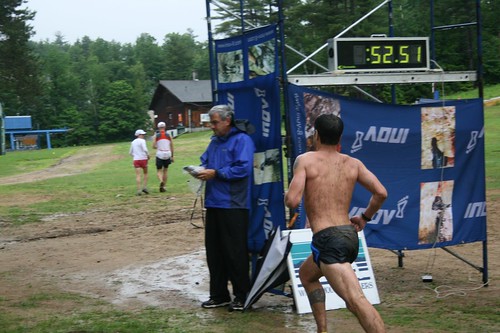
(Photo courtesy Kristin Wainwright, Copyright 2008)
The course for the 2007 Cranmore Hill Climb it seems has become legendary among runners who had the strength and stamina to finish it. I still get people telling me about their memories of that ridiculously steep downhill.
When it came time to make up a course for the 2008 race, I wanted to go exact opposite, making a steeper uphill, longer flatter downhill, but also add in some new trails and singletrack that people hadn't been on. I hoped the course would still be memorable and hopefully a fun change to the 2007 sufferfest. Little did I know that mother nature would add yet another twist into the 2008 edition, by adding in some torrential downpours and a little thunder and lightning.
Race morning for me started out a little different than last year. Since I was blessed with so many great volunteers and no Mountain Team qualifying race responsibilities, I was able to run in the race myself. That meant the morning of I had to remember to pack clothes to race in and not be stupid about what I ate. When I got to Cranmore with volunteer Mike Davis at about 6:30, we finished setting up race registration and gave out assignments to volunteers to help set up the finish line etc. The sky was pretty foggy and a light drizzle started around 8 am. Around 8:30 the drizzle became a pretty heavy rain with thunder. Fellow White Mountain Miler, Tim Livingston, had mentioned to me on Friday "wouldn't it be crazy if it rained race day?" Well, yes, it was.
By the time 9 AM got there, we all ran out to the starting area, I gave some quick pre-race instructions and off we went up the mountain. As soon as we got out on the grass slope past the first single track, the course was already drenched. That continued all the way up, with a little thunder in the distance, and we were running in and out of fog. Once we got up to the upper section on the Hurricane Trail (which the racers came down last year), I noticed the stream of water just running down the course. It was at that point that I heard a yell from behind me from Todd Brown saying "Nice Course, Paul!". Todd is probably the most talkative runner in mid-race I have ever run with. No matter how steep the course is or how much he's hurting, he always has enough time to make a comment. It helps to keep things light in the middle of a tough uphill. And anymore in these mountain races, I seem to measure my placement by where Todd and Abby Woods are. At Wachusett we were all together, At Washington, Todd left us both in his wake, and here I hoped to finish ahead of him, since I had the home course advantage and knew what was coming next. On the last push up Hurricane, fellow Miler Max Thomas said "look strawberries!" and picked a wild strawberry from the course and popped it in his mouth. You tend to notice a lot of things in the grass as you are power walking up a steep incline.
As we crested the top of the mountain at the Meister Hut, I took a swig of water and started the descent. I used to hate downhill running until about 3 years ago, when I began to fall in love with that uncontrollable feeling as you motor down a mountain trail. I had to remind myself to not go all out on the first lap as one thing that really kills me is the transition from down back to up. I kept the push down, and, just as I thought, slowed to a crawl as soon as we hit the uphill. I kept doing a combination of running and power walking on the way up, knowing if I could just gut it out until I got to the top I could push it more on the downhill. The second downhill finally came and I was able to go pretty well. I found I can catch people better on the steepest sections of the downhill so I did well on the initial descent down the Easy Street trail but then when we opened up more on the flatter sections of Gibson, I gained no more ground. The rest of the way down was a blast. I did a nice face plant in the Beechwood Glades when the mud just gave out under me as I turned but that made for a good war story as I then came down Beginner's Luck to the finish line with mud all over my shirt and legs. On my way down Gibson, 14 year old White Mountain Miler Peter Haine passed me like I was standing still. I was a little confused by this as he had also passed me on the uphill until I found out that he and Max Thomas got off course a bit on their 2nd uphill lap. I can only imagine what Peter's time might have been if had stayed on the course. Pretty impressive for a 14 year old.

In the front of the race, Justin Fyffe had a tremendous day, flying down the second down hill to beat Kevin Tilton in a time of 52:51. Just on Kevin's heels was Jim Johnson, who really gutted it out to the finish with a badly rolled ankle he took on the second downhill. The men's Master's race was a battle between Tim Van Orden and Dave Dunham. Dave got ahead of Tim on the second uphill but not by enough before Tim was able to overtake him on the last downhill. If you haven't had a chance to see Tim's video from last year's Cranmore race, go here. It's pretty entertaining and gives you an idea of how steep it was.
On the women's side, current LaSportiva USATF-NE Mountain Circuit Leader Abby Woods, took home the win, followed by local White Mountain Miler, Lynne Zummo. The Master's race was won by Kat Fiske who just turned 40 a few days before the race.
Thanks so much to all of the volunteers who made this race possible. It's somewhat of a logistics challenge to get the water stop manned at the top, the food all prepared, results in and finish line and water stops covered. A lot of people made that seem really easy and it's a sign of great volunteers when you can run in the race yourself. I'm sure I will forget a few names (my apologies) but a special thanks to Bernie and Eileen Livingston, Tim Livingston, Peter Haine, Dave and Nancy Drach, Donna Cormier, Candy Armstrong, Richard and Joanne Fedion, Lesbia Haine, Tad & Sheri Thomas, Dave McDermott, Anne Mellor, Brendan Dagan, Jen Campbell, Mike Davis and everyone else who helped out. The day could not have happened without you.
Another special thanks to all of the race sponsors, especially Inov8, who provided shoe prizes and great tshirts, Julbo, FuelBelt, EMS, and Hammer Nutrition for the rest of the prizes and product donations. As I was going up and down the mountain I kept thinking to myself how you couldn't make a race better suited to show off Inov8 shoes. I saw lots of people out in their 280s and 285s and 310s, all navigating the mud, roots and rocks pretty well.
And if the weather and mud wasn't enough, three people got off course on their second lap. As they mad their way back over to the course, they encountered 2 bears mating. Nothing like that site to make you want to pass the bears cautiously.
Thanks to all of the runners who came out and did the race. To see some great race photos, check out Kristin Wainwright's or Scott Mason's. A great race report by Jim Johnson here. If you have any other photos to share or a race story I can post please let me know.
See Tim Van Orden's Race Video report.
Next year, the course will change (like it does every year) to match whatever the WMRT Trophy course will be as it will serve as the 2009 USA Mountain Champs again. I don't know what it will be like yet but I'm sure it will have interesting twists of its own, just like every year.
On to Loon Mountain! That is, after I am walking normally again after Cranmore.
-Paul
Monday, June 16, 2008
Periodization and Organization
Many runners I know, do it just to do it. They go out and run, each day or every other day, and sometimes if they feel good they will push hard during a run. They will show up at the summer series and other races, race hard and be happy when they pr. But if you start to talk to them about a season plan or a lay out for the running year they shy away from it as a child does a difficult school subject.
I am not trying to compare an adult seeking to enrich their lives through a community athletic event to a pouting child. Rather, I point out that just like the child is nervous about the subject because they don't get the concept so too do runners shy away from long term and grander thinking because they are unfamiliar with the theories.
Other runners I know try to repeat the same week or two week period over and over again because some point in the past these workouts precursed a great race. What both of these fail to do is look beyond a kind of acute 5 - 15 day period to the larger frame of fitness.
USATF breaks the season into a preparatory phase, a pre-competitive phase and a competition phase with smaller training cycle's within. They use some pretty fancy USATF vernacular which I wont try to use, but rather condensed and in a laymen way it goes as follows.
1)Running to get ready to train : just easy running and one long run a week with an emphasis on establishing a good routine and getting mileage up.
2)Early quality training : easy running, a long run a week, and 2 or 3 w/o's a week gearing you for the next training with some emphasis on mileage still and perhaps a low key race to replace a w/o
3)High quality training : easy running, a long run a week and 2 or 3 w/o's a week that prepare you for the races to come and the occasional higher quality race
4)Racing : easy running, shorter long runs and 2 or 3 w/o's a week that are of less volume (not necasarilly intensity) with a clear emphasis on racing
A well organized season takes advantage of what was done before to accomplish the races and goals ahead. W/o's (workouts) can be done on hills, trails, roads and the track. Besides w/o's there is numerous supplemental training that can often make or break a season's goals if for nothing else prevent injury.
With this all being said you should remember that you get stronger the 24-72 hours after races and w/o's because your body has overcompensated for the damage that was done. This is an acute example of loading (the w/o or race) and unloading (the rest and easy runs over the next 24-72 hours). So if the body is subjected to a larger scale stress, set w/o's for a 3 or 4 week period, you will reap the benefits the weeks following.
If you are interested in this please check www.usatf.com and look under the coaching education section for related work, Jack Daniel's Running Formula is another great source, and as always my ears are open.
I am not trying to compare an adult seeking to enrich their lives through a community athletic event to a pouting child. Rather, I point out that just like the child is nervous about the subject because they don't get the concept so too do runners shy away from long term and grander thinking because they are unfamiliar with the theories.
Other runners I know try to repeat the same week or two week period over and over again because some point in the past these workouts precursed a great race. What both of these fail to do is look beyond a kind of acute 5 - 15 day period to the larger frame of fitness.
USATF breaks the season into a preparatory phase, a pre-competitive phase and a competition phase with smaller training cycle's within. They use some pretty fancy USATF vernacular which I wont try to use, but rather condensed and in a laymen way it goes as follows.
1)Running to get ready to train : just easy running and one long run a week with an emphasis on establishing a good routine and getting mileage up.
2)Early quality training : easy running, a long run a week, and 2 or 3 w/o's a week gearing you for the next training with some emphasis on mileage still and perhaps a low key race to replace a w/o
3)High quality training : easy running, a long run a week and 2 or 3 w/o's a week that prepare you for the races to come and the occasional higher quality race
4)Racing : easy running, shorter long runs and 2 or 3 w/o's a week that are of less volume (not necasarilly intensity) with a clear emphasis on racing
A well organized season takes advantage of what was done before to accomplish the races and goals ahead. W/o's (workouts) can be done on hills, trails, roads and the track. Besides w/o's there is numerous supplemental training that can often make or break a season's goals if for nothing else prevent injury.
With this all being said you should remember that you get stronger the 24-72 hours after races and w/o's because your body has overcompensated for the damage that was done. This is an acute example of loading (the w/o or race) and unloading (the rest and easy runs over the next 24-72 hours). So if the body is subjected to a larger scale stress, set w/o's for a 3 or 4 week period, you will reap the benefits the weeks following.
If you are interested in this please check www.usatf.com and look under the coaching education section for related work, Jack Daniel's Running Formula is another great source, and as always my ears are open.
Thursday, June 12, 2008
INOV8's Summer Series Starts
Kudos to the large turnout of racers and volunteer (thanks Kim) that came out in the rumored 100plus degree weather to run the first of INOV8's nine summer trail series. Many of the smiling, and sweaty, faces I recognized from Jackson. I guess some people are just gluttons for punishment. Well keep up the work and enjoy the "cool" break in heat to sneak out to the track or for an extra long run. I know I will.
Hope to see you all again, and many more, this Tuesday and/or Thursday!
Hope to see you all again, and many more, this Tuesday and/or Thursday!
Wednesday, June 4, 2008
hello!
hey fellow milers!
sorry for this last minute blog, but i just wanted to let you know that brendan and i will be at the track, thursday the 5th, for anyone who is interested in getting started with workouts or just talking shop.
we also plan on being at the fun runs on tuesdays, and once again the track on thursdays, through the 4 on the 4th race. during track days we will be doing an easy 1-2 mile warm-up followed by drills/strides. we will also be available for anyone who wants ideas on workouts/race strategies/etc and either a workout of our own or to share ideas and support you. (+1-2 mile cool-down).
if you would like to talk about anything from aches and pains to other tips on training please know that you are welcome and that we hope to point you in the right direction (left turns only).
sorry for this last minute blog, but i just wanted to let you know that brendan and i will be at the track, thursday the 5th, for anyone who is interested in getting started with workouts or just talking shop.
we also plan on being at the fun runs on tuesdays, and once again the track on thursdays, through the 4 on the 4th race. during track days we will be doing an easy 1-2 mile warm-up followed by drills/strides. we will also be available for anyone who wants ideas on workouts/race strategies/etc and either a workout of our own or to share ideas and support you. (+1-2 mile cool-down).
if you would like to talk about anything from aches and pains to other tips on training please know that you are welcome and that we hope to point you in the right direction (left turns only).
Friday, May 30, 2008
Running in New Orleans and Katrina
As I sit in the New Orleans Airport waiting for my flight back to Boston, I thought I'd drop a few notes about running down here in the Crescent City.
I've never been to New Orleans before and know little about it past a big party spot on Bourbon Street for Mardi Gras, Super Bowls and Hurricane Katrina. I always like to go for runs when I am traveling for work, as I feel like I get to see the real part of a city instead of just an airport and a hotel. If I am not familiar with the city I'll post a message on letsrun.com to find out about good running routes. The recomendation for New Orleans was to get to St. Charles Street and run on the grass strips along the Trolley tracks.
This was a very cool running route. I was running through the Garden District part of the city and felt fortunate to find grass to run on right smack in the middle of the city. At first I wondered was it ok to run right down the trolley tracks (i.e. on the tracks) but then soon discovered that everyone runs there. You just keep your eyes out for trolleys and move to the other tracks if one is coming.
The French architecture in the Garden District was beautiful, lots of historic buildings and houses to see. I wondered how bad the heat would be and learned the hard way that 87 degrees and 60 percent humidity was not the best conditions to do a long run in, but I managed, my body longing for the nice cool temps back in NH. When I went to run in the mornings at 6AM, it was "only 75" but still incredibly humid. I realize I could never live down here, I would wilt from this humidity.
The rest of my time in New Orleans was enjoyable, I got to sample all of the local foods, giving me plenty of reasons to get out and run to burn off the calories. The people I have met here have all been super friendly, lots of Southern hospitality.
OK, on to the memories that will stick in my brain forever-- As I was running along, I saw signs along the streettes that said "Evacuation Route" which made me think of Katrina and all of the damage it did down here. Things looked pretty good where I was and I was glad to see how much the city had rebuilt.
The next day, at the end of the conference I was at for work, I got to go for a ride with some colleagues down to the 9th Ward to see the real damage from Katrina. It's images I will never forget. Entire neighborhoods are gone, nothing but foundations left in many of them, old street lights ripped off their posts, utility lines sticking out of the sidewalk. Some have bravely rebuilt, leaving kind of a surreal image of new housing in the middle of a block of overgrown foundations. You still see houses that are nothing but piles of rubble, with condemned signs on them waiting to be torn down. A lot of the houses and buildings still have the spray painted codes on them from when the search crews went through the neighborhoods- you see the "TFW', meaning te building contained Toxic Flood Water, signs indicating how many dead animals and people inside the houses and what room the bodies are in.
It really struck me how damage the whole area still looks, especially when you consider that it was almost 3 years ago that the hurricane occurred.
We also drove along the levees and when you see them, you are left with thoughts that they still look woefully low and inadequate to hold back a hurricane. Katrina recovery is still all over the news down here- new engineering reviews of rebuilt levees and concerns that they are no better than they were before and that all of it could happen again with one bad storm. Watching the weather on TV, you see hurricane coverage like you see snow storm coverage near us, you get the feeling people will always be lookng over their shoulder waiting for the next big storm. This isn't news that makes its way on the National scene anymore but you can tell its very much on people's minds here.
As I leave New Orleans, I can only hope that people who lost everything will continue to persevere and rebuild. Parts of the city are incredibly beautiful but you also get the impression that large chunks of the worst hit areas will never completely recover, both from their losses and from the feeling that when they needed their government's help the most, they felt abandoned- and many still do. Those destroyed neighborhoods are an image that will never leave me memory.
-Paul
I've never been to New Orleans before and know little about it past a big party spot on Bourbon Street for Mardi Gras, Super Bowls and Hurricane Katrina. I always like to go for runs when I am traveling for work, as I feel like I get to see the real part of a city instead of just an airport and a hotel. If I am not familiar with the city I'll post a message on letsrun.com to find out about good running routes. The recomendation for New Orleans was to get to St. Charles Street and run on the grass strips along the Trolley tracks.
This was a very cool running route. I was running through the Garden District part of the city and felt fortunate to find grass to run on right smack in the middle of the city. At first I wondered was it ok to run right down the trolley tracks (i.e. on the tracks) but then soon discovered that everyone runs there. You just keep your eyes out for trolleys and move to the other tracks if one is coming.
The French architecture in the Garden District was beautiful, lots of historic buildings and houses to see. I wondered how bad the heat would be and learned the hard way that 87 degrees and 60 percent humidity was not the best conditions to do a long run in, but I managed, my body longing for the nice cool temps back in NH. When I went to run in the mornings at 6AM, it was "only 75" but still incredibly humid. I realize I could never live down here, I would wilt from this humidity.
The rest of my time in New Orleans was enjoyable, I got to sample all of the local foods, giving me plenty of reasons to get out and run to burn off the calories. The people I have met here have all been super friendly, lots of Southern hospitality.
OK, on to the memories that will stick in my brain forever-- As I was running along, I saw signs along the streettes that said "Evacuation Route" which made me think of Katrina and all of the damage it did down here. Things looked pretty good where I was and I was glad to see how much the city had rebuilt.
The next day, at the end of the conference I was at for work, I got to go for a ride with some colleagues down to the 9th Ward to see the real damage from Katrina. It's images I will never forget. Entire neighborhoods are gone, nothing but foundations left in many of them, old street lights ripped off their posts, utility lines sticking out of the sidewalk. Some have bravely rebuilt, leaving kind of a surreal image of new housing in the middle of a block of overgrown foundations. You still see houses that are nothing but piles of rubble, with condemned signs on them waiting to be torn down. A lot of the houses and buildings still have the spray painted codes on them from when the search crews went through the neighborhoods- you see the "TFW', meaning te building contained Toxic Flood Water, signs indicating how many dead animals and people inside the houses and what room the bodies are in.
It really struck me how damage the whole area still looks, especially when you consider that it was almost 3 years ago that the hurricane occurred.
We also drove along the levees and when you see them, you are left with thoughts that they still look woefully low and inadequate to hold back a hurricane. Katrina recovery is still all over the news down here- new engineering reviews of rebuilt levees and concerns that they are no better than they were before and that all of it could happen again with one bad storm. Watching the weather on TV, you see hurricane coverage like you see snow storm coverage near us, you get the feeling people will always be lookng over their shoulder waiting for the next big storm. This isn't news that makes its way on the National scene anymore but you can tell its very much on people's minds here.
As I leave New Orleans, I can only hope that people who lost everything will continue to persevere and rebuild. Parts of the city are incredibly beautiful but you also get the impression that large chunks of the worst hit areas will never completely recover, both from their losses and from the feeling that when they needed their government's help the most, they felt abandoned- and many still do. Those destroyed neighborhoods are an image that will never leave me memory.
-Paul
Subscribe to:
Posts (Atom)